
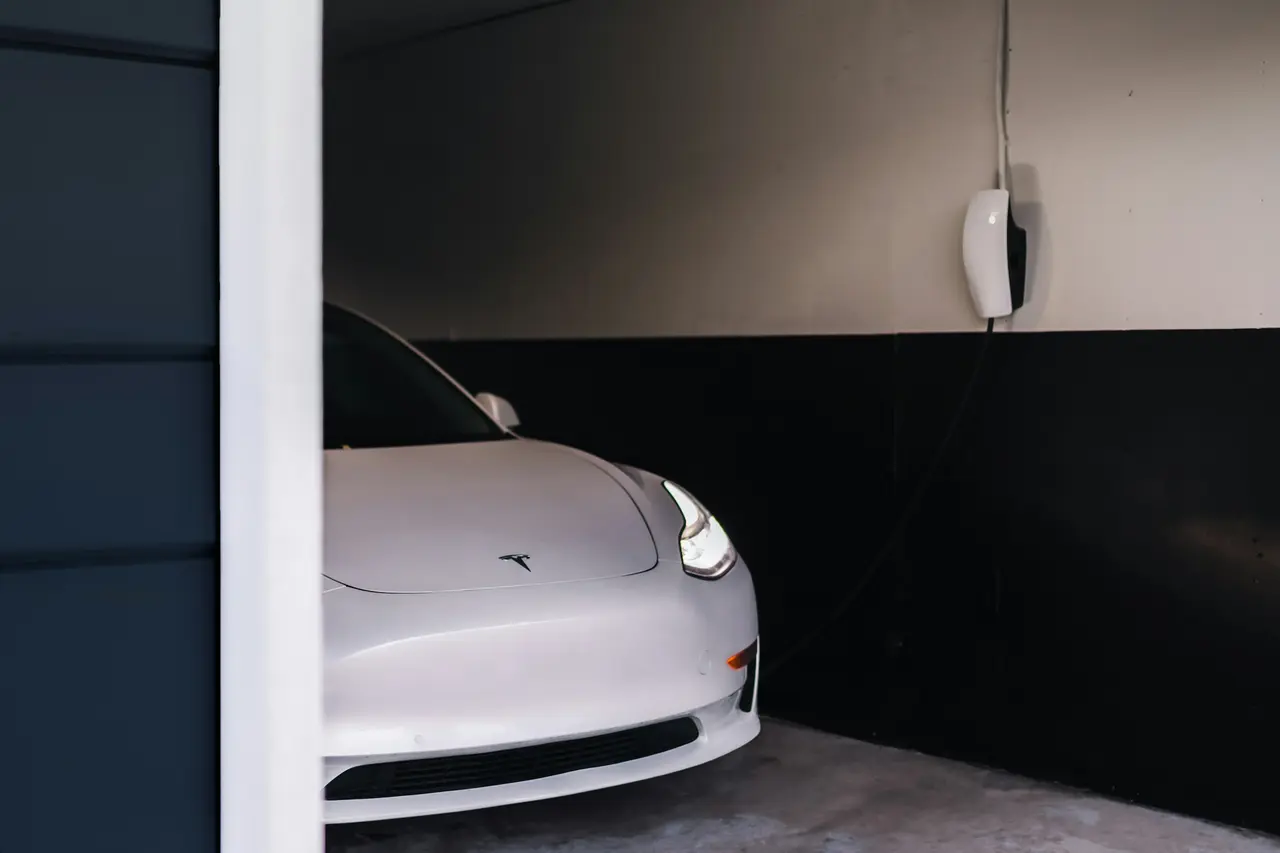
The short answer
If you drive an EV most days, a Level 2 charger on a dedicated 240-volt circuit is usually the practical choice. Before you buy one, find out whether your panel has room for the circuit and whether a load management device could avoid a service upgrade. Then plan for garage heat, get the permit, and ask APS or SRP about EV-friendly rate plans.
- Level 2 runs on 240 volts, usually a dedicated 40- to 60-amp circuit
- A load calculation shows whether your panel can carry it
- Load management can sometimes avoid a service upgrade
- Pick a charger and a spot that suit a hot garage
- Ask your utility about EV-friendly rate plans
If you drive an electric car most days, a Level 2 charger in the garage is usually the practical choice. It runs on 240 volts, typically on its own circuit, and it turns overnight charging into something you don’t have to think about. The questions that decide the job are how big a circuit your charger needs, whether your panel has room for it, and how the equipment will hold up in an Arizona garage in August.
Level 1 vs. Level 2 charging
| Level 1 | Level 2 | |
|---|---|---|
| Power | Standard 120-volt outlet | 240-volt dedicated circuit |
| Charging speed | Slow | Much faster |
| Installation | Often none, if the outlet is in good shape | New circuit, permit and inspection |
| Best fit | Short commutes, plug-in hybrids | Daily driving, long commutes, two-EV homes |
Level 1 can be enough if you drive short distances and the car sits overnight. If you go that route, have the outlet checked first. A garage outlet that also runs a freezer or shop tools, or one with worn contacts, can heat up when a car pulls power through it for hours.
Sizing the circuit
Level 2 chargers usually run on a dedicated 40- to 60-amp circuit, depending on the charger. The charger’s rated output and the manufacturer’s installation instructions set the breaker and wire size. Because a car can charge for hours at a stretch, the circuit is sized for that steady load under the code your city has adopted.
Two things worth knowing before you buy:
- Your car’s onboard charger caps its charging speed, so bigger isn’t always faster
- Many hardwired chargers can be turned down to fit a smaller circuit
Does your panel have room?
This is the step people skip, and it matters most in Phoenix. Air conditioning is the biggest electrical load in most homes from roughly May through October. A house that handles an EV charger easily in March can be near its limit on a July evening with the AC, the pool pump, the oven and the charger all running.
A load calculation answers the question properly. It counts what the house already uses and what you plan to add. Homes in newer master-planned communities often have 200-amp service and room to spare. Older homes with smaller service may be tight. If your panel is a Federal Pacific or Zinsco, plan to replace it before adding a new circuit.
The panel also needs physical space for a two-pole breaker. If it’s full, the answer might be a subpanel or a panel replacement.
Load management
A load management device watches your home’s total draw and slows or pauses charging when the house is close to its limit. It can sometimes avoid a service upgrade. Some chargers have this built in, and others work with a separate device at the panel. The trade-off is slower charging during the hours your house is busiest, which often doesn’t matter if you charge overnight.
Hardwired or plug-in
| Hardwired | Plug-in | |
|---|---|---|
| Connection | Wired directly to the circuit | Plugs into a 240-volt outlet |
| Moving it | Needs an electrician | Unplug it and take it with you |
| Wear points | No outlet to wear out | Outlet and plug take repeated use |
| Output | Can often use the charger’s full rating | May be limited by the outlet rating |
If you choose plug-in, use a heavy-duty outlet built for long, steady loads, on its own circuit. GFCI protection is required for garage outlets, and how that applies to a 240-volt outlet depends on the code edition your city has adopted.
Garage heat is a real factor
Phoenix summer highs regularly top 110°F, and a closed garage gets very hot. Heat is hard on electrical equipment. Breakers trip at lower loads when they’re hot, and connections loosen over many heat cycles.
- Check the charger’s operating temperature range on the spec sheet
- Keep it out of direct afternoon sun if it’s outside or near an open door
- Skip a west- or south-facing wall in full sun when you have a choice
- Ask that connections be torqued to the manufacturer’s specification
Some chargers reduce their output when they get too hot. That’s a protective feature, but it’s one more reason to pick a cooler spot.
Permits and inspection
A new 240-volt circuit for an EV charger typically needs an electrical permit from your city or county, followed by an inspection. Arizona’s handyman exemption only covers small jobs that don’t need a permit, so this is work for an ROC-licensed contractor. Permit rules are set locally, so confirm with your own building department.
Check your utility’s EV rate plans
APS and SRP both offer time-of-use and EV-friendly rate plans, and which utility serves you depends on your address. Plans and prices change, so check with your utility before you finish setting up. Many cars and chargers let you schedule charging, which makes it easy to charge during the hours your plan favors. Charging late at night also keeps the charger off your panel during the evening AC peak.
EV charger planning checklist
- Your car’s maximum home charging rate
- A charger temperature rating that suits your garage
- Hardwired or plug-in, and whether the cable reaches the charge port
- A load calculation
- Load management if the panel is tight
- Permit and inspection included in the quote
- Your utility’s EV rate options
- Room for a second EV later
If you’re not sure your panel can take it, Precise Electrical can run the load calculation and tell you which one you need: a new circuit, a load management device or a bigger service.
Related services: EV charger installation, Electrical panel upgrades, Outlets, GFCI & AFCI